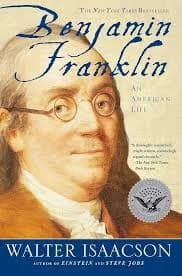
Benjamin Franklin: An American Life
By Walter Isaacson
ISBN: 9780743258074
Date read: 2024-10-02
How strongly I recommend it: 8/10
Franklin stopped arguing and started asking questions; his career took off after that shift.
MY NOTES
✅ Don’t argue for the sake of arguing. Instead, be curious and ask questions.
✅ A rule of human nature: People are more likely to admire your work if you're able to keep them from feeling jealous of you. The best way he thought to do this was to display a self-deprecating humor, unpretentious demeanor, and unaggressive style in conversation.
✅ He thinks of reading as a way to improve the mind.
✅ "Slow and steady diligence is the true way to wealth."
Frugality is learned at home.
Franklin’s parents were very hard workers. Franklin greatly cared about frugality.
Start early, even if it’s not your choice.
He went to an apprenticeship for his brother when he was 12.
Sometimes you want an idea partly "perhaps a little for dispute's sake."
Franklin wanted to build an academy for women, but Collins did not.
Arguing for the sake of arguing is a trap.
He soon started having arguments for the sake of having arguments but soon realized that was a mistake.
The alternative is the Socratic approach.
Ask questions and be the "humble inquirer" instead of contradicting everything.
Reading can be a skill gym, not just entertainment.
To practice his writing skills, he would read an essay, take notes, and try to reproduce it.
Imitation can become originality over time.
Once he did that enough times, he became an anonymous writer called Silence Dogood.
You can take a persona to take risks.
He was pretending to be a woman. His first essay got published in the paper.
Sometimes the only way to grow is to leave.
Franklin soon wanted a change, so he ran away from his brother to a different city.
Charm is leverage.
Franklin exploited his charm. He attracted people who wanted to help him.
Promises from powerful people can be fake.
The governor of Philadelphia told him he would pay for him to go to London to become a printer, but he lied.
If someone says they’ll fund your future, secure the money before you board the boat.
Franklin was on the boat and the governor didn’t give him money.
Social skill isn’t loyalty.
He realized he could make a lot of friends but couldn’t stick with them.
Beliefs can shift toward “do good” as a strategy for salvation.
Franklin became a Puritan or Calvinist, believing he could go to heaven by doing good deeds instead of only believing in God.
Preference is data.
He found himself more attracted to practical and reliable people rather than dreamy and romantic.
A promise of opportunity can pull you back.
Someone promised him a store in Philadelphia so he returned there to become a merchant.
Partnerships can become solo.
Franklin partnered with Meredith to make a printing business but soon after Meredith left, so it was his own.
Don't publish what you know is ugly.
When someone asked him to put something "scurrilous and defamatory," he declined.
Have a rule for your tongue.
His one rule was to "speak ill of nobody."
Make decisions by writing them down.
He made difficult decisions by making a pros and cons list and if a pro was equal to a con, he would cross them both out to see if the pros or cons list had more left over.
Choose a partner like a partner.
He valued practicality in a wife, preferring them to be a partnership that is mutually beneficial.
Loss doesn't care about your beliefs.
They had a son, Franky, who died when he was four from smallpox.
Maxims are mental tools.
"Three may keep a secret if two of them are dead."
"When there's marriage without love, there will be love without marriage."
"Necessity never makes a good bargain."
"Diligence is the mother of good luck."
"He who pursues two hares at once does not catch one and lets the other go."
"No gains without pains."
"Love your enemies for they will tell you your faults."
"There was never a good knife made of bad steel."
Credit often comes if you don’t chase it.
Franklin thought: “People will usually give you the credit if you don’t try to claim it at the time.”
Disrespect gets you nowhere.
He learned that disrespecting people doesn’t get anywhere and being kind and curious does.
Retire from money work to do curiosity work.
Franklin then retired when he was 42 to focus on people and science.
Some inventions are gifts, not assets.
Franklin would not patent his inventions; he would share them with the public.
Test ideas physically.
He proved dark materials soak in more heat by placing a dark material and light material in the snow and seeing which one melted more by the sun.
Humility can be strategic.
He was very humble by not publishing his kite and lightning experiment and giving credit to the French when he could have boasted about it.
Relationships can be a lifelong practice.
Franklin relished relationships with women and flirted with many young ones, even when he was married, but it was mostly playful.
Some friendships survive because you protect them.
He never lost a woman as a friend, even though he lost many male friends.
Public recognition can pull you away from home.
Franklin got invited to London and got celebrated for his accomplishments and went to talk about taxes for the colonies.
Big political goals start as a simple desire.
He wanted the colonies to band together and take over the British rule.
Choosing a side has consequences.
There was a fight between a group of racists and the Indians, and Franklin joined the Indians.
Distance can become neglect.
Franklin left again for London and didn’t return for years. He wrote to his family, but not too often.
You can fight for justice and still be hypocritical.
Franklin fought to abolish slavery, but he had slaves of his own.
Achievement doesn’t guarantee loyalty.
While his wife was dying in America, Franklin was playing chess against a fashionable woman in England. He wouldn’t return to America even when his son begged him to.