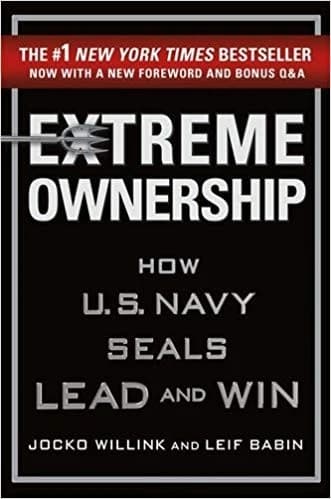
Extreme Ownership
By Jocko Willink; Leif Babin
ISBN: 9781250183866
Date read: 2026-05-22
How strongly I recommend it: 10/10
If your team is struggling, this book argues the problem starts and ends with you.
MY NOTES
✅On any team in any organization, all responsibility for success and failure rests with the leader. The leader must know everything in his or her world. There's no one else to blame. The leader must acknowledge mistakes and admit failures, take ownership of them, and develop a plan to win.
✅The good seal leaders took ownership of failures, sought guidance on how to improve, and figured out a way to overcome challenges of the next generation. The best leaders checked their egos, accepted blame, sought out constructive criticism, and took detailed notes for improvement.
✅How is it possible that switching a single individual, only the leader, had completely turned around the performance of an entire group? The answer: leadership is the single greatest factor in any team's performance. Whether a team succeeds or fails is all up to the leader. The leader's attitude sets the tone for the entire team. The leader drives performance or doesn't. This applies not just to the most senior leader of an overall team but to the junior leaders of teams within the team. There are no bad teams, only bad leaders.
✅Waking up early was the first example I noticed in the SEAL teams in which discipline was really the difference between being good and being exceptional. Those who were at work before everyone else were the ones who were considered the best operators and they were the most respected. It all tied back to discipline. The moment the alarm goes off is the first test. It sets the tone for the rest of the day. The test is not a complex one. When the alarm goes off do you get up out of bed or do you lie there in comfort and fall back to sleep? If you have the discipline to get out of bed, you win. You pass a test. If you are mentally weak for that moment and you let the weakness keep you in bed, you fail. Though it seems small, that weakness translates to more significant decisions but if you exercise discipline, that too translates to more substantial elements of your life.
✅When it comes to standards as a leader, it's not what you preach; it's what you tolerate. When setting expectations, no matter what has been said or written, if substandard performance is accepted and no one is held accountable, if there are no consequences, that poor performance becomes a new standard. Therefore leaders must enforce the standards
✅Leaders must never be satisfied. They must always strive to improve and they must build that mindset into the team.
✅Good leadership is contagious. In summary, whether or not your team succeeds or fails is all on you. Extreme ownership is a concept to help you make the right decisions as a key leader so that you can win.
✅It's not what you preach; it's what you tolerate.
✅ Principle: The people you're trying to lead have to understand why. If you don't believe in it fully then there is no way that they will either. In order to convince and inspire others to follow and accomplish a mission, a leader must be a true believer in the mission even when others doubt and question the amount of risk. The leader must believe in the greater cause. If a leader does not believe, he or she will not take the risks required to overcome the inevitable challenges necessary to win and they will not be able to convince others, especially the frontline troops who must execute the mission, to do so. Leaders must always operate with the understanding that they are part of something greater than themselves and their own personal interests. They must impart this understanding to their teams down to the tactical level, operators on the ground, far more important than training or equipment. A resolute belief in the mission is critical for any team or organization to win and achieve big results.
✅Human beings are generally not capable of managing more than 6-10 people particularly when things go sideways and inevitable contingencies arise. Now no one senior leader can be expected to manage dozens of individuals, much less hundreds. Teams must be broken down into manageable elements of four to five operators with a clearly designated leader. Those leaders must understand the overall mission and the ultimate goal of the mission, the Commander's intent. Every tactical level team leader must understand not what to do but why they are doing it.
✅A good plan must enable the highest chance of mission success while mitigating as much risk as possible. There are some risks that simply cannot be mitigated and leaders must focus on those risks that actually can be controlled. Whether on the battlefield or in the business world, leaders must be comfortable accepting some level of risk. “Those who will not risk cannot win.”
✅The true test for a good brief is not whether the senior officers are impressed. It's whether or not the troops that are going to execute the operation actually understand it. Everything else is bullcrap. You need to brief so that the most junior man can fully understand the operation, the lowest common denominator. The most important part of the brief is to explain your commander's intent. When everyone participating in an operation knows and understands the purpose and end state of the mission, they can theoretically act without further guidance.
✅As a leader if you are down in the weeds planning the details with your guys, you will have the same perspective as them, which adds little value. If you let them plan the details, it allows them to own their piece of the plan and it allows you to stand back and see everything with a different perspective, which adds tremendous value. You can then see the plan from a greater distance, a higher altitude, and you will see more. As a result you will catch mistakes and discover aspects of the plan that need to be tightened up, which enables you to look like a technical genius just because you have a broader view. Mission planning played an integral part in our success on the battlefield. The right process mattered. Disciplined planning procedures mattered. Without them we would have never been successful.
✅Leading up the chain: If you get frustrated with the chain of command, ask yourself, "Do they want me to fail?" Realize that it's your fault and you should be doing a better job of communicating what you need to them because they do not want you to fail.
✅Waiting for 100% right and certain solution leads to delay in decision and inability to execute. Leaders must be prepared to make an educated guess based on previous experience, knowledge of how the enemy operates, likely outcomes, and whatever intelligence is available in the immediate moment.
On Excuses
As is common in teams that are struggling, the original leader of boat crew 6 almost certainly justified his team's poor performance with any number of excuses. In his mind, the other boat crews were outperforming his, only because those leaders had been lucky enough to be assigned better crews. His attitude reflected victimization. Life dealt him and his boat crew members a disadvantage, which justified poor performance. As a result, his attitude prevented his team from looking inwardly at themselves and where they could improve. Finally, the leader and each member of boat crew 6 focused not on the mission but on themselves: their own exhaustion, misery, and individual pain and suffering. Though the instructors demanded that they do better, boat crew 6 had become comfortable with substandard performance. No one took ownership, assumed responsibility, or adopted a winning attitude.
What did the new boat crew lead do differently? He exhibited Extreme Ownership to the fullest. He faced the facts: he recognized and accepted that boat crew six’s performance was terribke, that they were losing and had to get better. He didn’t blame anyone, nor did he make excuses to get justify poor performance. He didn’t wait for others to solve his boat crew’s problems. His realistic assessment, acknowledgement of failure and *ownership* of the problem were key to developing a plan to improve performance and ultimately win. Most important of all, *he believed winning was possible. *
On Ego
Implementing extreme ownership requires checking your ego and operating with a high degree of humility. In SEAL teams we strive to be confident but not cocky.
As a leader it's up to you to explain the bigger picture. This is a critical component of leadership.
Remember it's not about you or anyone else; it's about the mission and how best to accomplish it. With that attitude exemplified in you and your key leaders, your team will dominate.
On Teamwork
You need to work as a team, cover and move.
There were once two companies under the same parent company. One of the companies was lagging behind and making the other company stall. The other company got mad and started blaming the first company without looking to see what they could do to help. They thought it wasn't their business to help the other company; they should stay focused on theirs and it'll all get figured out in the end. After hearing about Extreme Ownership they decided to help the other company improve their efficiency and work as a team because the enemy should be outside not inside the same company.
On Overwhelmed
**Prioritize and execute.** Even the greatest battlefield leaders cannot handle an array of challenges simultaneously without being overwhelmed. I had to remain calm, step back from my immediate emotional reaction, and determine the greatest priority for the team, then rapidly direct the team to attack the priority. I could not allow myself to be overwhelmed and to relax, look around, make a call.
To implement Prioritize and Execute in any business, team or organization, a leader must:
Evaluate the highest priority problem.
Lay out in simple, clear, and consistent terms the highest priority effort for your team.
Develop and determine a solution, seek input from key leaders and from the team where possible.
Direct the execution of that solution, focusing all efforts and resources toward this priority task.
Move on to the next highest priority problem. Repeat
When priorities shift within the team, pass situational awareness both up and down the chain
Don’t let the focus on one priority cause target fixation. Maintain the ability to see other problems developing and rapidly shift as needed. I explained how a leader who tries to take on too many problems simultaneously will likely fail at them all.
Getting others to Lead
I trusted them to lead. My ego took no offense to my subordinate leaders on the front lines calling the shots. In fact I was proud to follow their lead and support them. With my leaders running their teams and handling the tactical decisions, it made my job much easier by enabling me to focus on the bigger picture.
What a Leader Must Be
A leader must lead but also be ready to follow. Sometimes another member of the team might be in a better position to develop a plan, make a decision, or lead through a specific situation. Good leaders must welcome this, putting aside ego and personal agendas to ensure that the team has the greatest chance of accomplishing its strategic goals. A true leader is not intimidated when others step up and take charge. Leaders that lack confidence in themselves fear being outshined by someone else.
A leader must be aggressive but not overbearing. SEALs are known for their eagerness to take on tough challenges and accomplish some of the most difficult missions. Some may even accuse me of hyper-aggression, but I did my utmost to ensure that everyone below me in the chain of command felt comfortable approaching me with concerns, ideas, thoughts, and even disagreements if they felt something was wrong or thought there was a better way to execute. I encourage them, regardless of rank, to come to me with questions and present an opposing view. I listen to them, discuss new options, and came to a conclusion with them, often adapting some part or perhaps even all of their idea if it made sense. That being said, my subordinates also knew that if they wanted to complain about the hard work, they best take those thoughts elsewhere.
A leader must be calm but not robotic. It is normal and necessary to show emotion. The team must understand that their leader cares about them and their well-being, but a leader must control his or her emotions. If not, how can they expect to control anything else? Leaders who lose their temper also lose respect. But at the same time, to never show any sense of anger, sadness, or frustration would make that leader appear void of any emotion at all, a robot. People do not follow robots.
A leader must be confident, but not cocky. Confidence is contagious, a great attribute for a leader in a team, but when it goes too far, overconfidence causes complacency and arrogance, which ultimately set the team up for failure.
A leader must be brave but not foolhardy. He or she must be willing to accept risk and act courageously, but must never be reckless.
Leaders must have a competitive spirit but also be gracious losers. They must drive competition and push themselves and their teams to perform at the highest level, but they **must never put their own drive for personal success ahead of the overall mission success for the greater team.** They must act with professionalism and recognize others for their contributions.
A leader must be attentive to details but not obsessed by them. A good leader does not get bogged down in the minutia of a tactical problem at the expense of strategic success. That leader cannot get sucked into the details and lose track of the bigger picture.
A leader must be strong but likewise have endurance, not only physically but mentally.
Leaders must be humble but not passive, quiet but not silent. They must possess humility and the ability to control their ego and listen to others.
A leader must be close with subordinates but not too close. The best leaders understand the motivations of their team members and know their people, their lives, and their families. A leader must never grow so close to subordinates that one member of the team becomes more important than another or more important than the mission itself. Leaders must never get so close that the team forgets who is in charge.
A leader must exercise extreme ownership. Simultaneously, that leader must employ decentralized command by giving control to subordinate leaders.
Finally, a leader has nothing to prove, but everything to prove. By virtue of rank and position, the team understands that the leader is in charge. A good leader does not gloat or revel in his or her position. Since the team understands that the leader is de facto in charge, in that respect a leader has nothing to prove. In another respect, the leader has everything to prove. Every member of the team must develop trust and confidence that the leader will exercise good judgment, remain calm, and make the best decisions when it matters most. Leaders must earn their respect and prove themselves worthy, demonstrating through action that they will care for the team and look out for their long-term interests and well-being.
Generally, when a leader struggles, the root cause behind the problem is that the leader has leaned too far in one direction and steered off course. Awareness of the dichotomies in leadership allowed this discovery and thereby enables the correction.