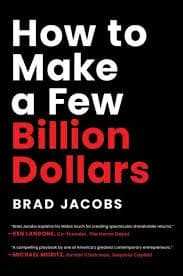
How to Make a Few Billion Dollars
By Brad Jacobs
ISBN: 9798886451740
Date read: 2025-06-03
How strongly I recommend it: 10/10
A serial billionaire shares the hiring rules, deal filters, and leadership habits that actually built his companies.
MY NOTES
✅ Technique to raise morale: pick one person who deserves your gratitude. Write notes to yourself on why you're grateful (problem-solver, customer-service all-star, fun to be around). Then sit with them, notes in hand, and say it directly. Giving and receiving gratitude can create an overwhelming happiness that lasts weeks or months.
✅ Instead of asking “How was your day?” ask, “What was the happiest part of your day?” You’ll get the good parts.
✅ To combat negative thoughts, use a two-step rule. Step one: acknowledge the negativity as your natural, self-critical psychology kicking in. Step two: challenge the validity of that perspective: millions of years ago, our psyche was programmed to default to anxiety and fear for survival.
✅ When I notice I’m anxious, I ask a basic CBT question: “What's the worst that can happen and how would I cope with that?” Or: “If a friend had a similar worry, how would I advise them to handle it?” Distance creates objectivity, and objectivity makes room for better outcomes.
✅ When you're trying to make a few billion dollars, your team will be running in multiple directions at a fast pace. Accept that some goof-ups are inevitable, and it gets easier to keep your mental equilibrium while you pursue big goals.
✅ Intentional daydreaming can change how we see our world. Thought experiments aren’t limited to genius scientists.
✅ Meditation has been my main hobby since I was a teenager. It helps me stay calm and think creatively under pressure. I do 15 minutes in the morning and 15 minutes at night, and much of that time is daydreaming. Profound calmness is where many of my best decisions materialize.
✅ When my energy is low, my favorite technique to rejuvenate and unleash creativity is to close my eyes and let my attention gently float to my brain. Feeling the brain technique: stare at your hands for a few minutes and the strong brain-hand connection can trigger dissociative, trance-like experiences. My version is similar, but I place awareness on my brain, close my eyes and "feel" it like a tactile sensation. I might see sounds, hear colors, or smell emotions.
✅ If you want to make money in the business world, get used to problems, because that's what business is. Find problems, embrace them, even enjoy them. Each problem is a chance to remove an obstacle and move closer to success.
✅ Life can be uncomfortable, but you can accomplish a lot if you can reframe uncomfortable things into something you can use.
✅ Successful people are self-aware enough to avoid three leadership traps: believing you're right no matter what, believing other people must share your opinions, and believing every inch of a course of action must be analyzed before you act.
✅ If you want to earn huge, you need to think huge. Set goals bigger than what you currently believe you can do, because that stretch can help you do it. Picture success clearly: how much money, by when, how you'll feel, what you'll spend it on, invest in, donate to, and whose lives you'll improve.
✅ If I had tried to do everything I wanted to, I never would have accomplished anything big. Narrow your focus to your most important dreams. Tune out the rest.
✅ Thinking you know it all is a trap, because you don't, at least I don't. Stay humble, and you'll keep advancing.
✅ If you want to make a lot of money in almost any industry, plan to invest heavily in tech. Ask: is the industry growing much faster than GDP? What base price/Volume combination do we need for it to be profitable?
✅ If you plan to make a few billion dollars, you'll likely find that sleep is overrated, and that it's actually more fun to be awake.
Brad's research tips on a market
I use a three-part methodology: educate myself on the industry as thoroughly as possible, compile a list of questions that matter, then get in front of the most knowledgeable experts I can find.
I start by reading everything: journals, periodicals, newspapers, trade publications, employee reviews on recruiting sites. I study the websites and social media of major players and up-and-comers. I watch YouTube interviews with CEOs. I also search the SEC database with lots of data on publicly traded companies.
After absorbing the data and building questions, I seek out people who live and breathe the industry. Some can be video chats, but this phase is more about face-to-face and listening intently.
Brad’s thoughts on the future
Artificial intelligence is emerging as a central determining factor in whether industries and businesses will collapse or prosper. What’s clear is that AI’s impact will eventually exceed anything we can imagine.
“I don't think we'll need a human insurance broker in 10 years.” He can also see AI replacing much of what paralegals and even lawyers do. Many jobs in journalism, advertising, and communications may become obsolete. Ironically, AI also puts tech jobs at risk, including coding.
At the same time, there's money to be made by spotting industries that benefit strongly from AI over the next 20 years: parts of healthcare, retailing, and manufacturing.
He thinks CEOs will get replaced too. Any human function that can be broken into rules, systematic processes, and logical decision making based on historical results can be replaced. Tech will keep improving as AI evolves. Someday, everything he does as CEO will be done more effectively by a robot or hologram with more knowledge and ability.
Brad thinks the Singularity is Near, and humans will merge with machine to create a new species.
Brad thinks 3D printing will be huge and reduce the need to ship low-cost items overseas from China. Trend one. Trend two is electric vehicles. If someone makes hydrogen fuel cells more viable for automobiles, that could be an emissions-free alternative to fossil fuels he could really get behind.
Brad's businesses
Amerex Oil: Brad had a major advantage because of his in-house database system in the '80s. It normally took weeks to hear back from a client with fax, but his database made it hours. Invest in technology.
How to do lots of high-quality M&A without imploding
Acquisitions are the best way he knows to scale fast and get the advantages of lots of locations and greater market share.
Scalability is one of the first things he studies in a business plan.
The easiest way he knows to create tremendous shareholder value is to buy businesses at profit multiples lower than the multiple his stock trades at, then significantly improve those businesses.
Instead of competing with big companies, he went to places like the upper Peninsula of Michigan to be a big fish in a small pond.
He’ll only do deals where the downside scenario is still good for the company, the base case is excellent, and the upside cases are off the charts. If the analysis shows more risk, he moves on.
The deals he avoided contributed more to his success than the deals he did.
He wasted time early in M&A thinking he could pay less by playing hard to get. He learned it’s better to let sellers know how excited he is, and the price and terms that work for him.
Brad on hiring
An empty seat is less damaging than a poor fit.
Brad looks for four traits: intelligence, hunger, integrity, and collegiality (kindhearted).
Intelligence: intelligent people turn problems into opportunities. They enjoy problem solving. The CEO trait most closely correlated with organizational success is a high IQ. Hire people smarter than you. To guard against arrogance, Brad asks: can they think dialectically (multiple perspectives)? And can they change their opinion?
Hunger: compensation is his most effective motivator. If a candidate says, "I'm not motivated by money," he suspects they're not being candid or they lack the hunger needed in a profit-driven enterprise. Sometimes he tells his heaviest hitters to chill out, turn off your phone, rest, recharge, and come back swinging.
Integrity: people show integrity through actions. Reputations come from the cumulative effect of doing what you say you'll do, and being straightforward in how you speak. He looks for those cues throughout hiring.
Collegiality: work gets more productive with people who lift the vibe.
Overpay for talent. Build profit sharing that marries personal interests to the company’s.
How to run electric meetings
Three ingredients: the right people, a crowdsourced agenda, and an atmosphere where everyone feels safe to respectfully disagree.
He believes lively discussion is the best way to help people learn in business settings.
If you’re talking about a document, have everyone read it first at their own pace before the meeting. Then the meeting is review, not discovery.
Talk about the good and the bad. Conflicting opinions are the purpose of the meeting.
At the end, have each participant stand, look at another person, address them by name, and say: “I’m proud to be on the same team as you because…”
Set few rules, but cast them in stone: turn off all devices. One person talks at a time. Give full attention. Keep an open, receptive mind. Disagree, but disagree respectfully.
If someone is wrong, don’t just tell them. Validate first: “I see your point, but” or “I agree with you directionally, but”.
Instead of using a script in a meeting, make it an email. Make meetings spontaneous and answer people’s Q&A.
How to kill the competition instead of killing each other
Collaboration is the most effective lever for furthering a company’s strategy and vision.
A mind-blowing book called the Superorganism influenced his thinking about culture. Ants collaborate extremely well, like every well-run human operation. The goal is balancing superorganism with human individuality, and understanding both.
He doesn't believe there's such a thing as over-communicating. Employees want more from management about what's going on. At XPO, he regularly did onscreen meetings with frontline groups like truck drivers. Keep a consistent cadence to internal communication.
His strategy for board members is similar: connect as often as reasonable, with as much openness as possible. He views the board as his boss, so he speaks with 100 percent unvarnished honesty.
The ability to truly hear another person is a kind of superpower. He’s taken many courses on active listening because he believes in it.
To condition managers to embrace open communication: at the end of a meeting, each attendee calls out two statements made by others: one they agree with, and one they disagreed with, plus the reasons. Making disagreement routine depersonalizes it in a constructive way.
To make sure every employee is happy, he sends a survey every 90 days asking four questions: How likely are you to recommend this company as a place to work? How can we fix the situation if you’re not happy? What’s your single best idea to improve our company? What’s the stupidest thing we’re doing as a company? The senior team reviews every response (10 days), then sends results to everyone for full transparency.
Some CEOs obsess over competitors; others pretend they don't exist. He thinks neither extreme wins. Focus on customers day-to-day, but don't ignore rivals.
Summary: the best way he knows to build team culture is prioritizing collaboration and open communication. That lets the rest of culture building shine.
Conclusion
His top priorities are family, his understanding and experience of life, and his work. He spends most of his time on those three. Given his work, it creates large positive impacts for society like jobs and charitable partnerships. But honestly, he ranks family and life experience half a notch higher.
He believes people who push for extraordinary outcomes are inherently winners, embodying the traits described here.