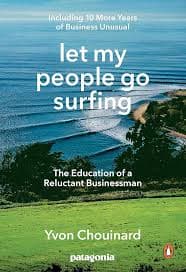
Let My People Go Surfing: The Education of a Reluctant Businessman
By Yvon Chouinard
Date read: 2026-05-19
How strongly I recommend it: 10/10
Patagonia's founder explains how treating quality and values as strategy outperforms chasing profit.
MY NOTES
This book is an example of the following maxims:
• Build the product you want to use
• Start in a niche
• Follow your passion
• Don’t do anything that someone else can do
• Do the opposite of what competitors are doing
• Don’t be afraid to ask for help
• Similar to Apple, they wanted to make the best product possible, even if that meant it was more expensive.
• It’s best to work in small teams
✅ The typical young Republican dream of making more money than his parents or of starting a business, growing it, and taking it public as fast as possible, and retiring to the golf courses of Leisure World has never appealed to me.
✅If you want to understand the entrepreneur, study the juvenile delinquent. The delinquent is saying with his actions: "This sucks. I'm going to do my own thing." Since I had never wanted to be a businessman, I needed a few good reasons to be one. One thing I did not want to change even if we got serious: Work had to be enjoyable on a daily basis. We all had to come to work on the balls of our feet and go up the stairs two steps at a time. We needed to be surrounded by friends who could dress however they wanted, even be barefoot. We all needed to have flex time to surf the waves when they were good or ski the powder after a big snowstorm, or stay home and take care of a sick child. We needed to blur the distinction between work and play and family.
✅I've always thought of myself as an 80 percenter. I like to throw myself passionately into a sport or activity until I reach about an 80% proficiency level. To go beyond that requires an obsession and degree of specialization that doesn't appeal to me. Once I reach that 80% level, I like to go off and do something totally different.
✅Sometimes good ideas spring from having a sense of where you want to go or having a vision of the next level of products. For example, I was walking around the Sporting Goods show in Chicago when I saw a demonstration of some polyester football jerseys being cleaned of grass stains. The company that made the football jersey fabric had developed a process that permanently edged the surface of the fiber so that the surface was hydrophilic, water-loving. This is the perfect fiber for underwear. Our more conservative employees wanted us to phase in the new materials slowly, especially because we were introducing cinchilla at the same time. Yet you can't wait until you have all the answers before you act. It's often a greater risk to phase in products because you lose the advantage of being first with a new idea.
✅Looking back now, I see that we've made all the classic mistakes of a growing company. We failed to provide the proper training for the new company leaders in the strain of managing a company with eight autonomous product divisions and three channels of distribution exceeded their management skills. We never developed the mechanisms to encourage them to work together in ways that kept the overall business objectives in sight.
✅We also were the target of several lawsuits. None involved faulty equipment or climbers. We were sued by:
• A Window washer
• A plumber
• A stagehand
• Someone who broke his ankle in a tug-of-war contest using our climbing ropes.
The basis of each suit was an improper warning, that we had failed to properly warn these customers about the dangers inherent in using our equipment for uses we could not predict.
✅When Yvon was confused about what he wanted the company to be, he had one of his board members write down a list of their values that they wanted to use in the future. And overnight they became a much more focused and sober-minded company, which limited their growth to a sustainable rate, spent carefully, and managed thoughtfully. Within three years, they eliminated several layers of management, consolidated inventories into a single system, and brought the sales channels under central control. Having the philosophies in writing as well as the shared cultural experience of the classes played a critical role in the turnaround. I've heard that smart investors and bankers don't trust a growing company until it has proved itself by how it survives its first big crisis. If that's true, then we've been there. Yvon would also have philosophy classes with employees.
✅Designing from the foundation of filling a functional need focuses the design process and ultimately makes for a superior finished product as compared with designing with the fabric and then finding a function for it. Without a serious functional demand, we can end up with a product that although it may look great, is difficult to rationalize as being in our line (i.e., who needs it).
✅When I die and go to Hell, the devil is going to make me the marketing director for a cola company. I'll be in charge of trying to sell a product that no one needs, is identical to its competition, and can't be sold on its merits. Remember, I'm a kid who couldn't play competitive games. I'd much rather design and sell products so good and unique that they have no competition.
✅Business is a Race to see who can be the first to bring product to the customer, and inventions and ideas are born simultaneously around the world by any number of unrelated individuals. It is almost as if every idea has its time.
✅Coming in second, even with a superior product at a better price is often no substitute for just plain being first. This means we “discover” a new process instead of “chasing” trends or products or “inventing” since that takes too long.
✅“If you wait for the customer to tell you what to do you’re too late. My customers didn’t want a model T, they wanted a faster horse. -Henry Ford
✅If you can connect with users at the beginning of their journeys, you can really make loyal customers for life.
✅A company needs to be profitable in order to stay in business and to accomplish all of its other goals. However, profitability should not be in the mission statement and it should not be the goal.
✅We believe that quality is no longer luxury, it is sought out by the consumer and it is expected. In fact, the Strategic Planning Institute has found that overall, companies with high product and sales quality reputations have on average return on investment rates 12 times higher than their lower quality and lower priced competitors.
✅A chief in an American Indian tribe was not elected because he was the richest or had a strong political machine. He was often chosen as chief because of his bravery and willingness to take risks, and for his oratory skills, which were invaluable for building a consensus within the tribe.
✅The best managers are never at their desks, yet can easily be found and approached by anyone reporting to them.
✅A study done on all these successful CEOs found that they all have one thing in common: they love working with their hands. If something needed fixing, they would always figure out how to do it themselves. The longevity of a CEO's career is directly proportional to his or her problem-solving skills and ability to adapt and grow with the job.
✅When a problem comes up, the effective CEO does not immediately hire a consultant. Outsiders don't know your business the way you do. In any way, I found that most consultants come from a failed business. By confronting the problems and trying to solve them yourself, you'll prevent them from happening again in another form. The key to confronting and truly solving any problem is to continue to ask enough questions to get past all the symptoms and reach the actual cause. A form of the Socratic method or what Toyota management calls asking the "five whys.”
✅When there is no crisis, the wise leader or CEO will invent one, not by crying wolf, but by challenging the employees with change. You might think that a nomadic society packs up and moves when things get bad. However, a wise leader knows that you also move when everything is going too well. Everyone is laid back, lazy, and happy. If you don't move now, then you may not be able to move when the real crisis happens. Teddy Roosevelt said, "In pleasant peace and security, how quickly the soul in a man begins to die." And as Bob Dylan says, "He not busy being born is busy dying."
✅You must be the change you wish to see in the world -Gandhi
✅It seems to me if there is an answer, it lies in these words: restraint, quality, and simplicity. We have to get away from thinking that all growth is good. There's a big difference between growing faster and growing stronger.
History
Yvon was a misfit since childhood. Students in school would make fun of him. He got D's in class, and it would always go retreat to the lake where he could fish. He was also a troublemaker and would get in trouble frequently in school.
The gear that he was using was from Europe and wasn't for the specialized climbing that he was doing in Yosemite. So he decided to buy a used coal-fired forge from a junk yard. A 138 pound anvil and some tongs and hammers to teach himself blacksmithing, to make his own hardware.
I had no business experience, so I started asking people for free advice. I'd call the presidents of banks and say, "I've been given these companies to run, and I have no idea what I'm doing. I think someone should help me." And they did. If you just ask people for help, if you just admit that you don't know something, they will fall all over themselves trying to help.
At a time when all outdoor products were tan, forest green, or at the most colorful of rust, we drenched the Patagonia line in vivid color. We introduced cobalt teal, French red, mango, seafoam, and iced mocha. Patagonia clothing, still rugged, moved beyond bland looking to blasphemous. And it worked. The rest of the industry spent the better part of a decade catching up.
The presence of children playing in the yard or having lunch with their mothers and fathers in the cafeteria helped keep the company atmosphere more familial than corporate. We also offered mostly for the benefit of new parents, but also for other employees, flexible working hours and job sharing.
We measure our success on a number of threats averted:
• Old growth forests that were not clear-cut
• Mines that were never dug in pristine areas
• Toxic pesticides that were not sprayed
We can't claim sole credit for these victories; we were merely funding the frontline activists. For the most part, the big problems had already been solved, and there were no crises except those that were invented by management to keep the company in *Yarak*, A falconry term meaning when your falcon is super alert, hungry but not weak and ready to hunt. The story is really about how we are trying to live up to our mission statement: "Make the best product, cause no unnecessary harm, and use business to inspire and implement our solutions to the environmental crisis."
Philosophies
Our Philosophies aren't rules, they're guidelines. They're the keystones of our approach to any project. And although they are set in stone, their application to a situation isn't.
In any long-lasting business, the methods of conducting business may constantly change, but the values, the culture, and the philosophies remain constant. At Patagonia, these philosophies must be communicated to everyone working in every part of the company so that each of us becomes empowered with the knowledge of the right course to take without having to follow a rigid plan or wait for orders from the boss. Living the values and knowing the philosophy of each part of the company aligns us all in a common direction, promotes efficiency, and avoids the chaos that comes from poor communication
Product Design Philosophy
The first part of our mission statement, "make the best product," is the cornerstone of Patagonia. Striving to make the best quality product is the reason we got into business in the first place. Because without a tangible product, there would obviously be no business, and the other goals of our mission statement would thus be irrelevant.
Our clothes, from baggies to flannel shirts, from underwear to outerwear, have to be the best of their kind. "Make the best" is a difficult goal. It doesn't mean “among the best” or “best at a particular price point.” It means “make the best”, period
When talking about our product design philosophy, we ask ourselves a few questions:
• Is it functional?
• Is it multi-functional?
• Is it durable?
• Is it repairable?
• Does it fit our customer?
• Is it as simple as possible?
• Is the product line simple?
• Is it an innovation or an invention?
• Is it a global design?
• Is it easy to care for and to clean?
• Does it have any added value?
• Is it authentic?
• Is it beautiful?
• Are we just changing fashion or designing for our core customer?
• Does it cause any unnecessary harm?
Is the product line simple: The proliferation of colors and patterns drains profit. Think what a mushrooming of styles can do. We've worked out an interesting formula. Each product Patagonia adds to the line requires the hiring of two people. The best performing firms make a narrow range of products very well. The best firm's products also use, up to 50% fewer parts than those made by their less successful rivals. Fewer parts means a faster, simpler, and usually cheaper manufacturing process. Fewer parts means less to go wrong, quality comes better built-in. And although the best companies need fewer workers to look after quality control, they also have fewer defects and generate less waste.
Production Philosophy
Maintaining a sense of urgency throughout a company is one of the most difficult challenges of business. The problem is further compounded by having to depend on outside suppliers who may not have the same sense of expediency. I constantly hear people giving lame excuses for why something is impossible or why a job needs to get done on time. Here are a few examples:
• I wish I could help you, but we can't get any more fabric.
• I've called and called, but I can't get through.
• The computer screwed up.
• I didn't have the time.
• Impossible.
There are different ways to address a new idea or project:
If you take the conservative scientific route, you study the problem in your head or on paper until you are sure there is no chance of failure. However, you have taken so long that the competition has already beaten you to the market.
The entrepreneurial way is to immediately take a forward step, and if that feels good, take another. If not, step back. Learn by doing, it is a faster process.
My relationship with our best producer Leffler taught me how important it is for the **designer to work with the Producer upfront**. Because I had no training in engineering but did know what I wanted a carabiner or ice screw to do, I would show up with a simple sketch or carved wooden model or just an idea in my head, and we would work together to come up with a design that was feasible. This applies to every product. Building a house proceeds more smoothly and less expensively when the architect and contractor work out the real-world problems of a blueprint before the cement truck shows up to pour the foundation.
Develop Long-term Relationships with Suppliers and Contractors
Patagonia has never owned a fabric mill or a sewing shop. To work effectively on a single endeavor with so many other companies, with no compromise in product quality, requires a level of mutual commitment much deeper than the traditional business relationship. Mutual commitment requires nurture and trust, and those demand personal time and energy.
The first thing we look for in a supplier or contractor is the quality of its work. If the standards aren’t high already, we don’t delude ourselves into thinking they’ll be raised for us, no matter how attractive the price.
Weigh quality first against on-time delivery and low cost.
Every production department of every company has a mandate to deliver a quality product on time at a reasonable cost. Although management's job is to treat these three goals as complementary rather than contradictory. What does a company do? What it must choose?
Patagonia puts quality first. For a sales-driven approach, a company might sacrifice a degree of quality to achieve on-time delivery. A mass marketer might sacrifice both quality and on-time delivery to make the lowest cost.
But if you're committed to making the best products in the world, you can brook no allowance for fabrics that fade on the shelf or zippers that fail or buttons that fall off. Of course, if you do choose quality against on-time delivery or against paying a reasonable price, don't pat yourself on the back. You've already blown it. You have to strive constantly to achieve all three, but quality is “more equal”.
Go for It, but Do Your Homework
You can minimize risk by doing your research and most of all by testing. Testing is an integral part of the Patagonia industrial design process, and it needs to be included in every part of the process. It involves:
• Testing competitor's products
• Quick and dirty testing of new ideas to see if they're worth pursuing
• Fabric testing
• Living with a new product to judge how hot the sales may be
• Testing production samples for function and durability
• Test marketing a product to see if people will buy it
You identify the goal and then forget about it and concentrate on the process.
Measure Twice, Cut Once
It’s better to find the problem early
Borrow Ideas from Other Disciplines
The drive for quality in production in any organization has to go beyond the products themselves. It extends to how we organize ourselves to get a body of work done, how we beg, borrow, and steal good ideas from other companies and cultures, and how we approach the question of the way things are and how they should be. That begins with an attitude of embracing change rather than resisting it. Not just changing without reflection and weighing the relative merits of the new ideas, but nonetheless assuming that if we look hard enough, there may be a better way to do things.
Philosophy of Architecture
The following are guidelines we used in creating a new retail store or office building that will optimize aesthetics, function, and responsibility.
1. Don't build a new building unless it's absolutely necessary. The most responsible thing to do is to buy used buildings, construction materials, and furniture.
2. Try to save old or historic buildings from being torn down. Any structural changes should honor the historical integrity of the building.
3. If you can't build retro, build quality. The aesthetic life expectancy of the building should be as long as the physical materials life-span.
4. Use recycled and recyclable materials like steel grinders, studs, re-milled wood and straw bales.
5. Anything that is built should be repairable and easily maintained.
6. Buildings should be constructed to last as long as possible, even if it initially involves a higher price.
7. Each store must be unique. The heroes, sports, history, and natural features of each area should be reflected and honored.
Marketing Philosophy
At Patagonia, our story is about ourselves. It’s much easier to tell nonfiction than fiction. Our story is based on our founders and employees we now have a book division which publishes books on the environment, the sports we do, and our ambassadors. We produce films on the same topics, and the Patagonia website is chock-full of video stories and product information. Social media, especially, is a powerful tool.
Branding is telling people who we are. Promotion is selling people and our product.
Our promotional efforts begin with the product. A new product, particularly one that is so radically different from anything out there that the consumer didn't even know existed or realize he or she needed, needs to be promoted. When we reinvented ice climbing tools, we not only had to write the manual on their use but also had to write the book "Climbing Ice."
It's easy to promote a game-changing product because there is no competition, and there are great stories to tell. If we come out with a product that is difficult to promote, it's probably because it's no different than anyone else's, and we probably shouldn't be making it.
We have three general guidelines for all promotion efforts by Patagonia, both within and beyond the pages of the catalog:
1. Our charter is to inspire and educate rather than promote.
2. We would rather earn credibility than buy it. The best resources for us are the word-of-mouth recommendations from a friend or favorable comments in the press.
1. We advertise only as a last resort and usually in sport-specific magazines.
We make certain assumptions about our customers, not just that they are intelligent. We assume that they don't shop as entertainment, that they're not out to buy a life, that they want to deepen and simplify, not junk up their lives, and that they are fed up with or indifferent to being targets for aggressive advertising. We know that for customers as well as ourselves, the most valued advice we can receive is that from a trusted friend. After that, we respect the opinions of pros or experts like outdoor instructors, climate guides, fishing guides, or river outfitters.
The best way to get press is to have something to say.
Financial Philosophy
Who are businesses really responsible to? Their customers, shareholders, employers, or employees? We should argue that it's none of the above. Fundamentally, businesses are responsible to their resource base. Without a healthy environment, there are no shareholders, no employees, no customers, and no business.
We are a product-driven company, which means the product comes first, and the company exists to create and support our products. This is different from a distribution company whose primary concern may be service rather than product. When you look closely at some of these companies, it may be a surprise to find that not all of them are in business to produce a tangible product or service. The real product may be the company itself, which is just being grown to be sold one day.
Our mission statement says nothing about making a profit. In fact, our family considers our bottom line to be the amount of good that the business has accomplished over the year. However, a company needs to be profitable in order to stay in business and to accomplish all of its other goals. If we wish to lead corporate America by example, we have to be profitable. No company will respect us no matter how much money we give away or how much publicity we receive for being one of those hundred best companies if we are not profitable. It's okay to be eccentric as long as you are rich; otherwise, you're just crazy.
We have to look ahead in other ways as well. It's the role of financial people not only to tell you what happened but also to prevent rude surprises in the future. A company should always be playing what-if scenarios. Example: What if all our top management goes down in an airplane crash? What if our warehouse burns down? What if our main computer melts down or gets a virus? We don't need operational plans already set up to deal with these crises, but we do need to identify which ones could strike so we are less likely to take a hit in the back of the head.
Human Resource Philosophy
If you care about having a company where employees treat work as play and regard themselves as ultimate customers for the products they produce, then you have to be careful whom you hire, treat them right, and train them to treat other people right.
Remember, work has to be fun. We value employees who live rich and rounded lives. Our policy has always allowed employees to work flexible hours as long as the work gets done with no negative impacts on others. A serious surfer doesn't plan to go surfing next Tuesday at 2:00. You go surfing when there are waves, and the tide and wind are right. This has led to our "Let My People Go Surfing" Flex Time Policy. Employees take advantage of this policy to catch a good swell, go bouldering in the afternoon, pursue an education, or get home in time to greet the kids when they climb down from the school bus. We found that rarely has any employee abused this privilege.
Management Philosophy
I believe that for the best communication to avoid bureaucracy, you should ideally have no more than 100 people working in one location. This is an extension of the fact that democracy seems to work best in small societies where people have a sense of personal responsibility.
Groups sized between four and seven people were most successful at problem-solving, largely because small groups are more democratic, egalitarian, mutualistic, cooperative, and inclusive. Hundreds of studies in factories and workplaces confirmed that workers divided into small group sizes enjoy less sickness, higher productivity, greater social interaction, and higher morale most likely because the conditions allow them to engage in what is best in being human: to share the meaning and fruits of their labor.
If for whatever reason we have another downturn in our business like we had in 1990-1991, our policy is to:
1. First cut the fat, freeze hiring, reduce unnecessary travel, and generally trim expenses
2. If the crisis were more serious, we would eliminate bonuses and reduce salaries of all top-level managers and owners
3. Shorten the workweek and reduce pay
4. Finally, as a last resort, lay people off
Environmental Philosophy
I'm pessimistic because I see no will in society to do enough about the impending doom. Yet there's no difference between a pessimist who says, "It's all over. Don't bother trying to do anything. Forget about voting. It won't make a difference," and an optimist who says, "Relax. Everything is going to turn out fine." Either way, the results are the same. Nothing gets done.
Before we are entitled to encourage other companies to act responsibly, we have to do so ourselves. There's only one way to lead, and that's by being in front and leading by example.
If the United States were to start taxing polluters, stop subsidizing such wasteful industries as oil, timber, and industrial agriculture, put levy taxes on all non-renewable resources, and correspondingly reduce the taxes on income, it would be the biggest step we could make towards becoming a sustainable society.
Among the multitude of threats facing life on Earth, there is none more threatening than global climate change. We have put at risk the very factors that make our planet habitable and unique from all other planets. You can't get anything done by standing on the sideline and doing business as usual. That's how we got here in the first place. It's not enough to be satisfied with setting a goal of not allowing our carbon dioxide levels to go above 300 parts per million.
Any company environmental philosophy should also include the encouragement of employee participation at home.
Many Patagonia employees go on the front line to fight the environmental crisis, but the main way Yvon combats it is by donating to nonprofits and societies that are on the front lines and by convincing other companies to act.
I would summarize the elements of this philosophy as follows:
1. Lead an examined life
2. Clean up our own act
3. Do our penance
4. Support civil democracy
5. Do good
6. Influence other companies