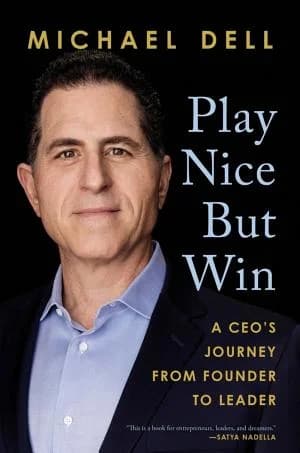
Play Nice But Win
By Michael Dell
Date read: 2025-08-08
How strongly I recommend it: 10/10
Dell beat rivals with better tech by mastering operations first; the priority order most founders get backwards.
MY NOTES
✅ If you sound like people, you’re more likely to sell to them. Michael even made up a Texas accent to sell newspapers.
✅ Michael treated his board with respect. He told them they could talk to anyone about anything. Everything should be open.
✅ One of the greatest fears after you succeed: living in a bubble of good news. Hearing only what you want to hear.
✅ Some people brag about multitasking. He wasn’t sure about that, but he knew he could compartmentalize. With 110,000 people, focusing intensely on one thing at a time is a survival skill, especially while being a leader, traveling, parenting, and keeping a total secret: taking Dell private.
✅ "I'm an optimist by nature; basically, I just feel it's a better way to live than the alternative. You don't start a company if you're not an optimist (a healthy appetite for risk helps too)."
✅ “Was I a little full of myself at 19? Sure, I was. I think you have to be to do anything important.”
✅ In business you can plan, hire geniuses, and prepare, and still get smacked in the face with a flounder: something you never anticipated. Expect the flounder.
✅ What Michael Dell does can look low-key because it's natural to him. The real advantage: he's so clear on where he's headed that he can ignore background noise and avoid the usual entrepreneur traps.
✅ Don’t assume that because your brand is great at one product, customers will trust you with a completely new product.
✅ “Growth, Growth, Growth” sounds cool until it breaks you. The order he learned: liquidity, profitability, and growth. In that order.
✅ The people who got you from point A to point B might not be the people who get you from point B to point C.
✅ Sometimes "culture problems" show up as soap opera. Ted (married, kids) gave a no-show job to his girlfriend the stripper. When she demanded hush money, Ted went away.
✅ Dell had a flat organization. Managers didn't have to get approval from higher-ups. Speed + ownership = massive growth.
✅ In 1986, a strong-willed 21-year-old sat in Intel's lobby demanding to see Andy Grove because he needed more 286 chips. Security tried to move him. He didn't move. He got the meeting, told Grove his quest, and Grove became a friend from that day. Some doors open when you become too annoying to ignore.
Growing up
Michael grew up in Houston, Texas. Dad: orthodontist with his own practice. Mom: real estate broker. Ambitious household, likely where the ambition came from.
They played with a rule: “Play Nice but Win.” That’s a whole life philosophy in five words.
As a kid: energy and curiosity. He imagined owning a company. Heroes became entrepreneurs who challenged the status quo: Charles Schwab, Fred Smith, Ted Turner, William McGowan, people he read about in business magazines and watched their stocks rise.
He haunted Radio Shack to mess with computers.
He worked early: orthodontist office, waiter, coin and jewelry store negotiating gold coin prices. He sold stamps and made good money.
He bought an Apple II with his own money and immediately took it apart. Word spread. He tutored other kids on computers and earned more. Joined HAAUG (Houston Area Apple User Group).
He invented a copy-protection method using half-tracks on floppy disks. He even saw Steve Jobs when Jobs visited Houston.
He bought an IBM 5150 and took it apart instantly, then noticed something important: IBM didn't actually make the parts. They rushed, pulled pieces from other companies, and assembled. That's a business lesson hidden inside a motherboard.
Selling newspapers
He sold newspapers for the Houston Post and learned targeting: newly married people and new homeowners were more likely to buy.
Summer before college
He spotted a weird IBM PC supply problem: companies ordered 5,000 and got 2,000. Chaos. Overstock here, understock there.
He exploited the mismatch: bought cheap from overstocked stores, drove a U-Haul to understocked stores, and made instant profit, using cash he already had (over $60,000) from other business.
Building Dell
He learned in Byte magazine. A lawyer asked him to “soup up” a machine after seeing Michael’s computer. The lawyer told friends. Friends asked what PC to buy. Michael instead bought parts and built PCs for them. That’s the business: do the work, own the relationship.
He was also planning on becoming a doctor, even though his passion was computers.
Culture drift warning: he discovered about 50% of team members said they’d leave for another company if paid the same. He realized they’d built a culture of stock price, financial performance, and “what’s in it for me?”
College
His parents pushed medicine. He hid computer inventory in his roommate’s bathroom when they visited. He finally convinced them with numbers: he was making $50,000 a month, and promised he’d go back if the business failed. He left college for good.
He met Terry selling computers and hired him as accounting/software manager/bookkeeper. Terry helped early, then stress crushed him. When Terry left, Michael was alone and afraid for the first time because he didn’t know what to do. That’s the hidden tax of growth: eventually you outgrow your own certainty.
Humble beginnings
They experimented and improvised. They made it up as they went.
He worked 16-hour days and kept a bed in the back office for nonstop nights.
IBM didn’t notice because they thought he was “mail order,” even though the accidental business model was superior.
In his limited free time, he devoured leadership and management books, filling the gaps he knew he had.
He feared the “Osborne effect”: announcing an upgraded product too early, killing current sales, revenue stops, bills stay, bankruptcy follows.
Dad
“I’ve achieved some pretty big things in business, but they all pale in comparison with the achievement of marrying Susan and raising our four children together.” That’s the scoreboard he cared about most.
Competitors
Servers had higher margins than PCs. Compaq used server profits to offset thin PC margins.
Dell worried: if Compaq dominated servers, they’d use that profit to attack PCs and crush Dell. That’s strategy: watch where your competitor gets fuel.
Others noticed Intel processors and Sun’s systems. Build something cheaper than Sun, and it changes the game. Sun left. HP copied Dell. The ecosystem eats itself.
After 9/11
“I completely understand how sad you are… But let’s not forget… we all have an incredible role to play in helping the country get back on his feet. Our customers need us… So let’s go back out there and get this done.” Grief plus mission.
Culture
He wrestled with a question: how to keep inner balance as a company during good and bad times, and build culture beyond revenue, profit, stock price.
In the Dell handbook, “We are committed to:
Building a culture of operational excellence.
Delivering superior customer experience.
Leading in a global market we serve.
Being known as a great company and a great place to work.
Providing superior shareholder return over time.”
Sleep & health
He developed travel-sleep methods: shift bedtime earlier for two or three nights before big time-zone trips. Once you arrive: get up early and exercise. Don't sleep midday.
Things I believe
Curiosity: keep learning, have big ears, be open to ambiguity. Design your company from the customer back.
Use facts and data to decide. Be objective, humble, and willing to change your mind if the facts and data say so. Scientific method works in business.
Commitment, drive, grit, determination, perseverance, indomitable will.
Try not to be the smartest person in the room. Surround yourself with people who challenge, teach, inspire, push you. Appreciate different talents.
Ethics and integrity are paramount. You can't succeed over time without them. Markets are long-term efficient. If you don't meet commitments or deliver bad product/service, people won't buy again.
The rate of change is increasing. It won’t slow down.
Change or die. “There are only the quick and the dead.” Reimagine constantly, especially around technology.
Ideas are commodity. Execution is not. Strategy is necessary, not sufficient. Execution requires detailed operational discipline.
Teams win championships. Put the team ahead of the player.
Life is taking a punch, falling down, getting back up, fighting again.
Never let a good crisis go to waste, and if there’s no crisis, create one to motivate change. Focus on what you can control. Crisis creates opportunity.
Don't be a victim. Victimhood is a losing mindset. Self-determination focuses away from what you can't control and drives forward.
Confidence not arrogance. Humility not ego.
Everybody gets angry. Don’t stay angry. Anger is counterproductive. Be motivated by helping others, love, family, country, compassion, mastery.
Be pleased, never satisfied. Improve continuously. Celebrate achievements, then look ahead.
Success is a horrible teacher. Setbacks and failures make you stronger over time if you learn.
Take risks. Experiment. Test. Small experiments build a path as change accelerates.
Humility, openness, fairness, authenticity.
Respect others. Treat them as you want to be treated.
Optimism, grow it in yourself, makes you happier.
Find purpose and passion by being part of something greater than yourself.