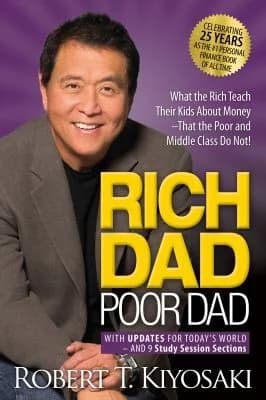
Rich Dad Poor Dad
By Robert T. Kiyosaki
ISBN: 9781612681139
Date read: 2025-10-07
How strongly I recommend it: 8/10
One question tells you if your money is actually working for you or just passing through.
MY NOTES
It’s not about how much money you make, it’s about how much you keep.
The rich buy assets. The poor only have expenses. The middle class buy liabilities they think are assets.
Assets put money in your account. Liabilities take money out.
Do not treat your house as an asset.
Wealth: If I stop working today, how long could I survive?
Wealth is the measure of the asset column compared with the expense column. When your assets generate enough income to cover your expenses, you’re wealthy, even if you’re not yet rich.
If you spend everything you make, then when your salary increases, you’ll likely just spend more.
A corporation is just a file folder with legal documents. It’s not a company or a group of people.
The ones who lose are the uninformed who just go to work every day and pay taxes. If they understood how the rich play the game, they could play it too. An employee with a safe job but no financial aptitude has no escape. My poor dad never fought back against taxes. My rich dad didn’t either. He just played the game smarter. He did it through corporations, the biggest secret of the rich.
Financial IQ comes from four main places: 1. Accounting (reading numbers) 2. Investing (money making money) 3. Understanding markets (supply and demand) 4. The law (tax protections of a corporation). Garret Sutton’s books on corporations should be read.
Business owners: 1. Earn 2. Spend 3. Pay taxes. Employees: 1. Earn 2. Pay taxes 3. Spend.
Section 10.31 of the Internal Revenue Code: Delay paying taxes on real estate sold for a capital gain by exchanging it for a more expensive piece of real estate. As long as you trade up in value, you won’t be taxed until you liquidate. People who miss this miss the chance to grow the asset column.
It is the bold that succeed, not the smart.
If you want to be a good investor: 1. Find an opportunity everyone else missed. 2. Learn how to raise money, and do what stops most people (not just banks). 3. Organize smart people. Listen to and hire people smarter than you.
Learning how to sell is a base skill for personal success. Buy courses to get better.
Work to learn, not for money.
Get a breadth of experience. It’s often better to switch jobs frequently than to stay in one place.
Remember the Alamo. They stayed and fought even when they knew they were going to lose.
There is a staggering difference between those that invest at 20 compared to 30.
Listening is more important than talking. If it wasn’t, God wouldn’t have given us two ears and one mouth.
Assets
Examples: Businesses that do not require my presence. I own them, but they are managed or run by other people.