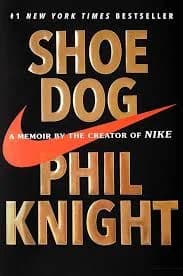
Shoe Dog
By Phil Knight
ISBN: 9781501135910
Date read: 2024-08-05
How strongly I recommend it: 10/10
Nike nearly died a dozen times; Knight's actual decisions show what separating a job from a calling costs.
MY NOTES
✅ Keep going no matter what comes.
“Just don’t stop.”
✅ Don’t tell people how to do things.
Tell them what to do, and let them surprise you with their results.
✅ Study leadership under extreme conditions.
His three heroes: Churchill, Kennedy, Tolstoy.
✅ Success has a cost you don’t notice until later.
Phil’s biggest regret: not spending time with his children.
✅ Don’t settle for a job, profession, or even a career.
Seek a calling. Even if you don’t know what that means, seek it.
If you’re following your calling, fatigue is easier to bear, disappointments become fuel, and the highs hit different.
✅ Luck matters, but effort buys more lottery tickets.
Hard work is critical. A good team is essential. Brains and determination are invaluable.
Luck may decide the outcome. But the harder you work, the better your luck.
✅ Sometimes quitting is genius, but quitting isn’t stopping.
Sometimes you give up this path and try something else.
Giving up doesn’t mean stopping. Don’t ever stop.
A good idea can come from a paper.
Phil wrote about Japan doing to shoes what they did to cameras, and treated it like a plan, not an essay.
Go to the source.
He flew to Japan, met a distributor, and got the shoes.
Belief sells.
He believed that if everyone ran a little each day, the world would be better, and that belief helped others believe in the product.
Send the product to the person who can multiply it.
He sent shoes to his track coach Bill Bowerman, and that relationship became the foundation.
Split the upside with the right partner.
Bowerman wanted in. They went 50/50.
At some point you have to jump.
He quit his accounting job and sold shoes out of his car.
Showing up in person can change outcomes.
When another guy tried to cut him out, Phil flew back to Japan, and got the founder to split territory instead of replacing him.
Sometimes you win by being bold enough to be “crazy.”
He later convinced them to make him the full US distributor by claiming he had offices east and west.
Then he bought an office and lived in it.
A supplier trying to own you can force your next evolution.
Kitami offered to buy 51% of Blue Ribbon, or they’d choose another distributor.
When the supplier squeezes, build your own supply.
After contract pressure and breaches, Phil went to a shoe factory and started making a new shoe.
A brand can come from anywhere.
“Nike” came from an employee’s dream.
Creative financing keeps you alive.
Instead of selling stock, they sold convertible debentures (he notes to look this up later).
When you’re tired of being dependent, you become the product company.
Nike stopped making shoes for someone else and started making their own.
Selling to the sellers matters.
They went to Chicago to sell the new shoes to salespeople, and it worked.
Design is storytelling.
The swoosh is “someone running past you.”
Debt can be a cliff.
Nike had major bank problems and owed a lot, and survived when Nissho paid off the debt after the FBI got involved.
Manufacturing strategy matters.
They chose Taiwan because it had many small factories instead of a few big ones.
Competitors will team up to force you into submission.
Several shoe companies banded together and tried to make Nike pay $25M to the government.
Near-death can push a company into the next stage.
They were close to bankruptcy. Going public became the fastest way to get cash.
Going public without losing control requires structure.
They sold two kinds of stock:
Group A to Phil + the board.
Group B to the public.
The scoreboard can change overnight.
After the IPO, Phil was worth $178 million.
Even huge wins come with revisionist longing.
He wished he could do everything all over again.
Memory is fragile.
After marrying Penny, he wished he’d recorded conversations with his best friends, because they’re gone forever.