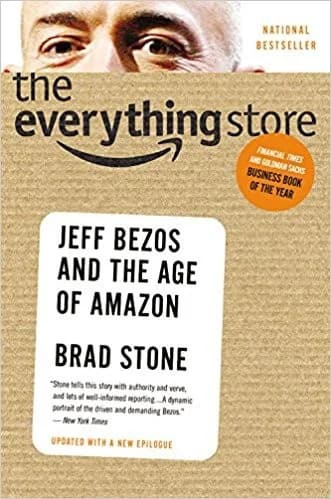
The Everything Store: Jeff Bezos and the Age of Amazon
By Brad Stone
ISBN: 9780316219280
Date read: 2024-07-23
How strongly I recommend it: 9/10
How Bezos actually ran Amazon: small teams, slow decisions kill growth, and missionaries beat mercenaries.
MY NOTES
✅ Communicate less, not more.
Coordination is a tax. The people closest to the problem should fix it.
✅ Avoid middle management by using autonomous teams.
"Two-pizza teams": if a group can't be fed with two pizzas, it's too big. He used ~10 people for this. It worked for some of Amazon, but not most.
✅ Protect thinking time.
Bezos would take time after the holidays to think and read (Bill Gates did this too). Reading is founder work.
✅ Be a missionary, not a mercenary.
Missionaries chase righteous goals and try to improve the world. Mercenaries chase money/power and run people over.
✅ Most slowdowns are decision failures.
The bottleneck is usually “we can’t decide,” not “we can’t build.”
Amazon is customer-centric, long-term oriented, and likes to invent.
Most companies aren't. They focus on competitors, not customers.
Admire people methodically.
Bezos admired Frank Meeks (Domino’s Pizza) and Alan Kay (“point of view is worth 80 IQ points”).
He never walked away from anyone without taking a lesson.
Start where the customer experience is predictable.
Books work because customers know what they’re getting: books are always the same.
To make something yours, you may have to leave the safe job.
Bezos left D. E. Shaw to start Amazon.
Use “regret minimization.”
He wouldn’t regret walking away from a bonus.
He would regret walking away from the internet opportunity.
Name like you mean it.
He chose “Amazon” because it’s the largest river and dwarfs the second largest.
Work-life "harmony," not "balance."
His values: work smart, hard, and long.
Interview personally, set a high bar.
Bezos interviewed potential hires himself and asked for SAT scores.
Ask questions to test thinking, not memorization.
“How many gas stations are in the US?” isn’t about the answer.
It’s about whether someone can invent a way to estimate.
Early growth hack: affiliate marketing.
Give companies 8% when they send people from their website to Amazon.
Don’t fold when incumbents threaten you.
Barnes & Noble said they’d build their own site and crush Amazon. Bezos didn’t give up.
Copying a competitor can fail, and still teach you.
Amazon tried to copy eBay-style auctions by buying a company. It failed. He learned from it.
Place bets early.
He put a lot of money into Google early.
Values as operating system:
Customer obsession. Frugality. Bias for action. Ownership. High bar for talent. Innovation.
Even if your only speed is "go," sometimes you slow down for discipline.
During the dot-com bubble, he focused on discipline and efficiency.
A childhood dream can become a company.
Bezos wanted to go to space as a kid. That helped drive Blue Origin.
Lowering the cost of space changes who gets to go.
Blue Origin’s goal: make space cheaper and safer so more people can go.
Hire builders to scale.
To expand Amazon, Bezos hired Jeff Wilke (MIT, MBA + engineering dual degree).
If the system is inefficient, build your own.
Bezos didn’t like the efficiency of the distribution system, so he created Amazon’s.
Hard work culture has tradeoffs.
Amazon was hard to work at. Google had better benefits and stole employees.
Going into a completely different market can pay off.
AWS was a new market for Amazon, it made billions.
Compete with end-to-end products using end-to-end thinking.
Apple's iPod succeeded as an end-to-end product.
Amazon did the same for Kindle: device + store + formats.
Control pricing friction (quietly).
They didn’t tell publishers the price of every book at $9.99 so publishers wouldn’t get mad.
This resembled Jobs’ 99 cents/song move.
A breakthrough product can reset your reputation.
Kindle was a turning point: it showed Amazon was innovative.
A turning point can shift what you focus on.
Kindle helped Jeff realize to focus on employees too.
Leverage can be political, too.
Bezos threatened to tear down fulfillment centers in Texas if they made him pay tax. Texas vetoed the bill.
On Decision Making
Compromise is low-energy.
But it doesn't lead to truth.
If truth is knowable (like the height of a ceiling), measure it.
Let juniors speak first and seniors last.
You get raw thoughts before people get swayed by authority.