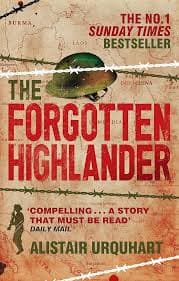
The Forgotten Highlander
By Alistair Urquhart
Date read: 2026-05-20
How strongly I recommend it: 10/10
One man survived the Death Railway, a hellship, and Nagasaki; then danced five nights a week at 90.
MY NOTES
✅Life is worth living, and no matter what it throws at you, it's important to keep your eyes on the prize of the happiness that will come. Even when the Death Rail Ray reduced us to little more than animals, humanity in the shape of our sanity medical officers triumphed over barbarism. Remember, while it seems darkest before the dawn, perseverance pays off, and the good times will return.
✅ reflecting on my happy childhood, my job in my family was a useful tool that I got used to to get me through some very hard times
✅Once you got started with sentimental and grief, you were a goner. It was a selfish tactic, but I was desperate to survive. I was refusing to let the Japanese win this. Some men found going easier by teaming up and making a close bond with another prisoner. They even took beatings together to share the blows and the pain. It was not the way for me. I watched the heartache of men losing their best pals and suddenly being left alone. They never usually lasted very long and soon followed their mates to the grave.
✅It's easy for these men to give up, and when they lose hope, the fight just seeps right out of them. On countless occasions, I have seen two men with the same symptoms and same physical state, and one will die and one will make it. I can only put that down to sheer willpower.
✅The Japanese had no consideration for our poor health or hunger and beat men across their backs with bamboo or rifles regularly enough to make us keep our heads down. It was a long first day, and if I had realized that it was just the first of 750 days I would spend as a slave in the jungle, I would have broken down and cried like a baby.
The construction of the Death Railway was one of the greatest war crimes of the 20th century. It was said that one man died for every sleeper laid. Certainly over 16,000 of us, British, Australian, Dutch, American, and Canadian prisoners died on the railway. Murdered by the ambitious of the Japanese Imperial Army to complete the lifeline to their forces in Burma by December 1943. Up to 100,000 native slaves, Thais, Indians, Malayans, and Tamils also died in atrocious circumstances.
✅One evening, hundreds of men milled about our normal spot on the hill. There was to be a concert, a break from the grinding monotony of camp life. As a music lover, I was thrilled. The boys were excited too. Somehow, goodness knows how, a piano had been dragged all the way up the hill. It was a brilliant moonlit night, and as the musicians arranged themselves, total and respectful silence descended on the huge crowd. Had it not been for the sound of crickets and tropical breeze, we could have been in the Albert Hall. Then, a solo violinist, a professional with the London Philharmonic called Dennis East stepped forward, and the plaintive notes of Mendelssohn's violin concerto reverberated around the hillside. It was the first music we had heard for months. I sat in trance, and the boys, strangers to classical music, were agog. For a few minutes, the beauty of the music lifted us out of the camp and reminded us of the greatness of European civilization that Japanese militarists despised. Some men wept. When East finished, several stunned seconds passed before rapturous applause and cheering broke out. It was so beautiful.
If we failed to bow, salute, or stand to attention at the approach of a guard, a beating would be administered.
We were all in various stages of berry-berry, pellagra, malaria, denigue fever, and dysentery. A new illness had also started to ravage some unfortunate prisoners called tinea. It was nicknamed "rice balls" because the hideous swelling had the tormenting tendency to attack and inflame the scrotum.
These slightly older men in their 30s and 40s seem to survive in much greater numbers. Surprisingly, it was the young men who died first on the railway. Perhaps the older ones were stronger emotionally. Perhaps with families they had more to live for. I sometimes wondered if I would die without having a family and without having a chance to live a life.
Nearly all the prisoners talked to themselves, and I was no exception. Every morning I would tell myself over and over, "Survive this day, survive this day, survive this day."
Occasionally, often with bizarre timing, I would have flashbacks to funny incidents from my childhood. Several men reported the same thing. Suddenly, quite out of the blue, we would be transported back in time to an astonishing and vivid experience. It must have been the mind's way of coping with the extreme stress.
Kidney stones tortured me for the next few years as a prisoner of war. The pain was so bad that I started to pray. The first time I had ever lent on God's ear in earnest. Even though I had to attend Bible class with the Boy Scouts, I never believed in a divine entity and was especially skeptical since I was forced to go to the classes. Gradually, the more I suffered and the more evils I witnessed, the more I began to believe. I turned to God several times. Often I felt my prayers went unanswered, but I somehow lived through the madness, and I think that someone must have been listening.
✅From an early period, the Japanese camp commandment who I've called the Black Prince became ever more intensive or inventive with his punishments. If they felt you deserved something more than a beating, it meant taking you aside and making you pick up a large boulder for the rest of the day. You had to hold onto the rock over your head in the blazing heat. Within minutes, your already weak and malnourished arm muscles would start to twitch and fail you. Before long, you would have to drop the rock (usually the size of a rugby ball or football) mindful you did so without letting it fall on your own skull. When you let go, the guards would pounce, fists, rifle butts, and boots flailing into your body until you picked up the rock again. It would go on all day.
The Black Prince's right-hand man was Sergeant Cici Okada, known to us Brits simply as Dr. Death. He loved tormenting us; he especially reveled in a sickening brand of water torture. He had guards pinned down the hapless victim before pouring gallons of water down the prisoner's throat using a bucket and hose. The man's stomach would swell up from the huge volumes of water Okada would then jump up and down gleefully on the prisoner's stomach. Sometimes, guards tied barbed wires around the poor soul's stomach. Some men died, but few survived.
✅When a prisoner was caught stealing from the Japanese officer's storeroom, or if a man turned on a guard, they received a next Grade on the sliding scale of Japanese torture. I called it the Indian Rope Trick. The helpless prisoner would be tethered, spread-eagled to the ground. They wrapped wet rattan (same string-like bark used to lash our bamboo huts together) around his ankles and his wrists and tied him to stakes in the ground. As the rattan dried, the ties would slowly gash into the skin, drawing blood and tearing into sinew and cartilage as it pulled limbs out of their sockets. It reduced even the toughest men to agonizing screaming, and they would be there all day.
✅One night, I awoke with dysentery calling. Holding my stomach, I reached to the patrones in the dark but on the way back, a Korean guard stopped me. He was talking frantically and pointing down at my midriff. I realized he was becoming frisky. ‘Jiggy, jiggy,’ he was saying, trying to grab me. I told him ‘No’. I bolted for my hut but his groaning summoned hordes of other guards and the Black Prince. Rifle hits and fists sent me to the ground. Someone stabbed me in the backside with a bayonet. Boots and fists flailed into my body before they hauled me up and dragged me to the front. They put me in the black hole which most people don’t come alive from. Malaria struck me down, causing uncontrollable shivers and pain that was diverted only when tropical ulcers and kidney stones reared to the fore. My hair matted, lice crawling all over me, no soap or water, no drugs or home, my degradation was complete
✅After all I had been through, I decided to stay apart from everyone else and focus totally on survival. I lived a day at a time in my own little world, a private cocoon, and adopted the position of self-sufficient loner. To survive each day required maximum concentration and alertness. It also meant that you had to conserve every possible ounce of energy. If someone spoke to me, I replied, but there was no memorable sense of community. I was so dang tired all the time that it was an effort to do anything but survive.
Dr Mathieson had the brainwave of bolstering the sick by injecting them with distilled water just under the skin. A placebo, it seems to really rejuvenate the men whether it was all in the mind or not.
As I was watering the Japanese plants, I heard a massive clap of thunder but thought nothing of it until a blast of heat knocked me down. I had just been hit by the second atomic bomb that instantly vaporized 35,000 people. A few days later, the Americans came to save us.
When I left Aberdeen I had weighed a healthy 135lbs but here in Nagasaki on the steel year scale, I was reduced to a skeletal 82lbs.
Home
Despite much encouragement and insistence, I could only pick at my food. I asked about Hazel, and without looking at me, Mum said she had married during the war and moved to Canada. I was not upset; in fact, I was glad that she had moved on and seemed happy.
Then Mum cleared her throat and told me nervously, "You should also know, Alistair, that your friend Eric didn't make it." I felt ill. I could barely lift my head, and the conversation buzzed around me. The words became jumbled, and I could no longer make them out as the kitchen walls seemed to close in. It was all too much, yet another kick in the face. Even though I had been around so much death, lived it and breathed it, nothing prepared me for the loss of such a close friend. All I could think of was, "Why then am I still alive? By what miracle had I returned home?”
Suddenly I snapped. I slammed my fork down on Mum's finest crockery plate and stood up. The chair screeched on the wooden floor. The rooms fell silent. It was so unlikely to make a scene, completely out of character. I knew they were trying to help, but I just couldn't stand it. I'm going out, I announced. I came back at 5:00 AM the next morning. I hated myself. I knew they were trying to be there for me, but I just wanted to be on my own. In many respects, my family felt like strangers.
How does one describe the feelings of a person who has been through something like we had, something no one could ever have invi-invised? They could never comprehend the depths of man's inhumanity to man or the awfulness of an existence that consisted of surviving one day at a time.
Dancing was the best rehabilitation I could have asked for, and it was also crucial to my reintegration into society. I slowly came out of my shell, and thanks to no small part to Mary.
Freddie got married but never came out of the camps, and he drank heavily to forget. Given his experience and his character, it should not have been a shock that he became an alcoholic. Despite the love he received from his wife, his family, and me and my family, he would die within 10 years of returning to the UK of cirrhosis of the liver, still a young man.
My experiences at the hands of the Japanese continue to haunt me, both physically and mentally, to this day. Even after I married, life could be hell. To this day, I suffer pain, and the nightmares can be so bad that I fight sleep for fear of the dreams that come with it. Yet I owed it to myself and to others who never made it back to make the most of my life.
I threw myself into a career and worked my way up to become managing director of another plumbing supplies business, making health and safety a priority for the staff. After what I had witnessed on the Death Railway, I enjoyed the work. My two children grew, and I took great pleasure from their success, as it did with my grandchildren, who came along and when they went to university. Life continued to throw up challenges after my wife Mary suffered a stroke, losing the power of speech. I nursed her for twelve and a half years, during which she was wheelchair-bound. I think that the experiences I had away and the inspirational example of our medics helped me cope during that difficult period.
At the age of 75, after Mary's death, I briefly emigrated to Canada to be close to my daughter. Yet I found myself lonely and isolated in a strange country. I decided to return to Scotland. Though all this, my sufferings as a prisoner taught me to be resilient and to appreciate life and all it has to offer. Back in Scotland, I quickly made new friends in the world of my lifelong passion, ballroom dancing. At 90 years of age, I am still working on my slow foxtrot. I dance an average of five times a week and organize two weekly tea dances.
My life has been long, rich, and rewarding, but always, always the ghosts of the River Kwai have remained with me. The cruel faces of the Black Prince, Dr. Death, and the mad mongrel have stalked my dreams for more than six decades now. In my thoughts and prayers, I will never forget the faces of all those young men who died looking like old men, those prisoners who endured terrible deaths in a distant land.