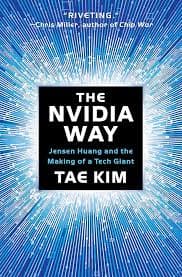
The Nvidia Way: Jensen Huang and the Making of a Tech Giant
By Tae Kim
Date read: 2026-05-21
How strongly I recommend it: 10/10
How Nvidia built a structure where decisions move faster than competitors can plan.
MY NOTES
✅When we were young, we sucked at a lot of things. NVIDIA wasn’t a great company on day one. We made it great over 31 years
✅Through these interviews I began to understand what makes nivida special. Its defining characteristic it is not technological prowess or financial resources. It is not a mystical ability to see the future, or luck. Rather, it is the unique organizational design and work culture that I have become to call the NVIDIA way.
✅Jensen runs the company in the way he does because he believes that NVIDIA's worst enemy is not the competition but itself, more specifically the complacency that grips any successful company, particularly one with a long and impressive track record such as NVIDIA.
✅If we have leaders who are not fighting for other people to be successful and who are depriving opportunities to others, I'll just say it out loud: I've got no trouble calling people out. You do that once or twice, nobody is going to go near that again.
✅Two things that remain constant about venture capital:
1. Founders whose startups already produce revenue are far more successful with their pitches than startups that have no products in the market
2. As with many things in the business world, success depends as much on who one knows as it does on how strong one's business is
✅Jensen was more of the market and business guy than the two engineers. He had the vision and story.
✅They had succeeded on the deal with Sequoia on the strength of their reputation, not their business plan or their demo. It was a lesson Jensen would never forget. Your reputation will precede you even if your business plan writing skills are inadequate. They got VC money before having a product
✅After the release of the NV1: “We thought we had built great technology and a great product. It turns out we only built great technology; it wasn't a great product.” It wasn’t compatible with the worlds most popular game : Doom
✅”We were diluted across too many different areas”, Jensen recalled. “We learned it was better to do fewer things well than to do many things, even if it looked good on a PowerPoint slide. Nobody goes to the store to buy a Swiss Army knife—it's something you get for Christmas. ”
✅Nvidia required employees to work long hours and sometimes over the weekend. Their hiring motto was “Hire someone smarter than yourself”. The company handled personnel in the same uncompromising way that it approached chip design.
✅”People may be smarter than me, but no one is ever going to work harder than me”. He was often in the office from 9 a.m. to near midnight, and his engineers usually felt obligated to keep similar hours.
✅Fear and anxiety became Jensen's favorite motivational tools. At each company meeting, he would say, "We're 30 days from going out of business." It was a hyperbole on one level, but it certainly wasn't a regular occurrence. Jensen didn't want any complacency to creep in even in successful people, and he wanted to confront new hires with the kind of pressure they would face going forward if they didn't have what it took. They needed to self-select out sooner rather than later.
✅“The #1 feature of any product is a schedule”
✅NVIDIA still wasn’t a large company, with only 250 employees. And it didn’t generate huge revenues; for the fiscal year 1999, it reported $158 million in sales. But it had spent years sharpening its focus on technical excellence and product execution. Now that focus was finally paying off in the form of something intangible, yet all important: industry influence.
✅I don't *think* people are trying to put me out of business. I *know* they're trying to.
✅I don’t like giving up on people, I’d rather torture them into greatness.
✅”I look on the mirror every morning and say, ‘you suck.’” Do your job. Don’t be too proud of the past. Focus on the future
✅It turns out that having a lot of direct reports, not having one-on-ones, we made the company flat, information travels quickly, employees are empowered. That algorithm was well conceived. When Jensen was told to get a COO to reduce his administrative burden, Jensen said, “No thanks, this is a great way to make sure everybody knows what’s going on. “ Even a general manager was allowed to attend every board meeting and offsite board event. Jensen would have a packed house. “It kept everyone in sync”
✅Strategy is not words. Strategy is action. We don’t do a periodic planning system. The reason for that is because the world is a living, breathing thing. We just plan continuously. **There is no five year plan.
✅Jensen would start every project with designating a leader, or “Pilot in Command” who would report directly to Jensen. He found this created far more accountability and far greater incentive to do the job well than did the standard divisional structure. Everything has to have a name attached to it because you have to know who's the PIC who's accountable.After Jensen organized Nvidia's employees into groups centralized by function, sales, engineering, operations, and so on, they were treated as a general pool of talent and not divided by business units or divisions. This allowed the people with the right skills to be assigned to projects on an ad hoc basis. It also helped mitigate some of the ever-present job insecurity that plagues corporate America.
✅”What made Jensen great is he is an engineer and he is a computer scientist” Former marketing executive Kevin recalls meeting Jensen on the street outside NeurIPS conference in Barcelona, Spain, in 2016. It's an academic conference held in December where machine learning and neuroscience experts present their latest findings. Kevin knew Jensen wasn't scheduled to speak and asked him what he was doing at the conference. Jensen replied, "I'm here to learn." NVIDIA's CEO had not assigned someone to attend and take notes on his behalf. He had shown up himself so he could absorb the recent developments in artificial intelligence. He wanted to be deeply involved in the space, attending sessions and talking with presenters, students, and professors. Later on he began hiring many of the people he met at the conference.
✅I don't actually know anybody who is incredibly successful who just approaches business like, "This is just business. This is what I do from 8 to 5 and I'm going home and at 5:01 I'm shutting down." Jensen has said, "I've never known anybody who is incredibly successful like that. You have to allow yourself to be obsessed with your work."
✅When he goes to the movies, Jensen says he never remembers the film because he spends his entire time thinking about work. I work every day. There's not a day that goes by that I don't work. If I'm not working I'm thinking about working. Working is relaxing for me.
✅He believes, in other words, that in the highly technical chip industry innovative engineering matters far more than financial metrics. That belief is perhaps a single thing that most differentiates Jensen from his peers.
✅When demand for generative AI exploded in 2023, Nvidia was the only hardware company ready to fully support it. And it was ready only because it was able to spot the early signals productive and insert those features into a line of chips that was only months away from arriving on the open market. It was all about their speed.
✅We don’t have the culture of just going after market share. We would rather create the market
✅Jensen understood that gamers who buy Nvidia cards are willing to pay for performance. “As long as they look at the screen and can see something radically different that they say before, they’re going to buy it. It doesn’t have to be cheap.
✅No one knows when this AI slowdown will happen, whether it is in 2026- or 2028, or more than five years from now. But history shows Nvidia will be prepared for the challenge. It will also be ready to adapt to the next big computing trend, regardless of what it may be.
✅Jensen is a technical founder and CEO which is part of Nvidias advantage over some of its competitors.
✅Paul Graham, who used to work at Yahoo, noticed that once they started losing the way for the best engineers to Google and Microsoft, the company began slouching toward mediocrity. “Good programmers want to work with other good programmers” Much of the time, that talent finds Nvidia first. More than a third of new hires are referred by current employees.
✅Nvidias executives had no qualms telling top technical architects at other companies that they are going to lose and they might as well join the winner
✅Jensen rewards performance by using stock grants, which are distributed on the basis of how important an employee is considered to the company. Jensen looks at stock like his blood
Introduction
In another life, Jensen Huang might have been a teacher. His prefereee medium is the whiteboard. At many of the meetings he attends at NVIDIA, where he has been CEO since 1993, he will leap up, his favorite chisel tip dry erase marker in hand, and diagram a problem or sketch out an idea even if someone else is speaking or white boarding that the same time
Chapter 1: Pain and Suffering
Jensens father fell in love with America after visiting New York. They moved Jensen and his brother to Kentucky to go to Oneida Baptist Institute boarding school.
Jensens relative youth, and likely his different ethnicity as well, made him a target of bullies. He was beaten up often in the first few months on campus. But Jensen taught his roommate to read, and his roommate taught him how to weightlift.
Lester in life, Jensens executives would say he had developed his tough, street fighter mentality during his days in Kentucky. “maybe this is a bit of my early schooling, I will never start a fight, but I will never walk away from one”
He found a ping pong teacher and got so good he went to tournaments in places like Las Vegas. He then got a job at Denny’s where he learned how to navigate chaos, work under time pressure, communicate with customers, and handle mistakes.
The biggest single factor that propelled him from scrubbing toilets to managing entire divisions of a microchip company was his willingness and ability to put more effort, and tolerate more suffering than anyone else.
“Greatness is not intelligence. Greatness comes from character. And character can only be the result of overcoming setbacks and adversity.” It is why whenever someone asks for his advice on how to achieve success, his answer has been consistent over the years. “I wish upon you ample doses of pain and suffering.”
Chapter 2/3: Birth of Nvidia
Jensen was at LSI logic and Priem and Malachowsky were at Sun Microsystems. Priem was the first one to quit his job, and the three of them would meet at Denny’s to talk about the business.
When Jensen left LSI, his manager brought him to the CEO who asked, ‘Can I invest’?
His manager also introduced them to Don Valentine from Sequioa Capital saying “Hey Don, we've got this kid who's going to leave Elise at Logic. He wants to start his own company. He's really smart. He's really good. You guys should take a look at him. “
Later, they met to discuss graphics needs for the Macintosh line. Nothing came out of the meeting
Sequoia met with Nvidia two more times and at the last meeting decided to invest $1 million. “If I lose my money, I will kill you”
Questions Don Valentine Asked
“Who are you? Are you a gaming console company? Are you a graphics company? An audio company? You have to be one”
“Where will you be in 10 years”?
Don hated product demos which was what Nvidia did, he just wanted to know what they were building, who it was for, and why they were going to be successful
Chapter 4: All In
We were just bad at our jobs, Jensen said. The first five years of our company, we had really talented people working super super hard. But building a company is a new skill. Jensen vowed that he would absorb as much as he could about leading a business to prevent himself and his fledgling company from ever making the same mistakes again. He gravitated towards the book "Positioning: Battle for Your Mind" by Al Ries and Jack Trout. In it, they argue that positioning is not about the product itself but rather about the mind of the customer who was shaped by prior knowledge and experience.
People tend to reject and filter out anything that doesn't align with their existing worldview, which makes it hard to change their minds with reason and logic. But emotions can change quickly, and a skillful marketer can manipulate people to feel a certain way about a product if a company uses the right message.
According to the two authors, potential buyers didn't want to be persuaded; they wanted to be seduced. But seduction requires a simple message, and Nvidia's message with the NV1 was far too complicated. It wasn't superior to the competition in any obvious way, and it actually was inferior under some circumstances.
Some interactions at Nvidia included late-night shenanigans, such as a time when the entire engineering division started measuring and recording the circumference of everyone's head, a sort of jocular phrenology.
With the conference coming up in a few months, Jensen decided to go all in on the next generation chip: REVA 128. They only had about six months to make and manufacture it, but it was going to take around 9, so Jensen bought a graphics card simulator for $1 million to lower the time. This meant there would only be six months left of wages than nine. He took a massive risk to do this.
“Jensen made deals that would save the company over and over again”
Bathroom Scene
As the day went on, no place at NVIDIA headquarters was safe from a drive-by grilling from Jensen.
Kenneth Hurley, a technical marketing engineer, was at a urinal when Jensen walked up to the one next to him.
"I'm not the kind of guy who likes to talk in the bathroom," Hurley said.
Jensen had other ideas. "Hey, what's up?" he asked.
Hurley replied with a noncommittal "not much." Which earned him a sidelong glance from the CEO. Hurley panicked, thinking "I'm going to get fired because he thinks I'm not doing anything. He's probably wondering what I'm doing at NVIDIA.”
To save face, Hurley proceeded to list 20 things he was working on, from convincing developers to buy NVIDIA's latest graphics card, to teaching those developers how to program new features on them.
“Okay”, Jensen replied, apparently satisfied with the engineer's answer.
Yelling Matches
When Jensen found out that the Revo 128's image capabilities looked terrible, he called several executives into his office where he had the issue spread open on a table. He demanded to know why the image looks so bad, and it was because they had to prioritize speed to get it done on time.
The shouting match got got so loud that it caught the attention of Walt Donovan, who assured Jensen that Nvidia's next generation of chips would not only solve the problem but also outpace the industry on every possible measure of graphics quality. It did little to placate Jensen, who at this point wanted to be left alone. "Get out!" he yelled.
Almost Bankruptcy
Jensen and Nvidia had to deal with problem after problem. Six months after the Riva 128 came out, which was their first profitable month. Their quarterly revenue fell by half from $28.3M to $12.1M, and their net losses ballooned from $1M to $9.7M. Investors thought Nvidia was doomed and only had a few weeks left. But Jensen's response to Nvidia's near-death from a production backlog was paradoxically to restructure the entire company in order to ship new designs even faster. He called people into his office to discuss strategy.
Jensen noticed that the time it took to make one chip in the industry was about 16 months, but the cycles of computer manufacturers recycled their products twice a year in the spring and fall. So Jensen would split the design team into three groups.
The first would design a new chip architecture, While the other two worked in parallel to the first to develop faster derivatives based on the new chip
This would allow the company to release a new chip every six months, in line with the PC makers' buying cycles.
Nvidia's rapid iteration meant the competition would always be shooting behind a duck, as Jensen described it. Nvidia's competitors would simply be overwhelmed.
“The #1 feature of any product is a schedule”, Jensen later said. They called this the "3 teams, 2 seasons" strategy. It had a philosophy that demanded employees operate at the speed of light, measuring performance against what was physically possible and not what other companies were doing or what Nvidia had accomplished or failed to accomplish in the past. And it had a corporate mantra, "We're 30 days from going out of business," that served as a warning about complacency and conveyed the expectation that everyone from the CEO on down had to work as hard as they possibly could, even if it meant sacrificing their lives outside of Nvidia.
Interesting idea: At Intel’s annual forum for developers, he showed up with a box of fifty Nvidia cards and visited vendors at every single booth, offering to replace the existing cards in their machines with Nvidia’s. This ensured developers could play with the newest Nvidia cards with little fear of a clunky installation process, frequent crashes, or poor performance.
Nvidias strategy of using parts of the chips that failed (they were going to be thrown away anyway) was dubbed, “Ship the whole cow”, a reference to how butchers find ways to use almost every part of the steer carcass, from nose to tail not just the prime cuts like the tenderloin and the ribs. The rest of the graphics industry would soon follow suit, especially as Nvidia's rollout of "Ship The Whole Cow" was responsible for nearly putting another one of its competitors, S3 Graphics, out of business.
CUDA
Jensen say the “Era of the GPU” coming and decided to create software to make it easier to use their GPU’s, calling it CUDA. At first, they wanted to release it to only the more expensive GPU’s, but Jensen figured it would only work if they took a massive risk and put it on every GPU. It cost them 80% in profits and many years, but they integrated it with every GPU, and it paid off in the billions
Culture
In video doesn't constantly fire people and rehire them. We take people that we have and we are able to redirect them to a new mission. Managers at NVIDIA were trained not to get territorial or feel like they own their people and instead got used to them moving around between task groups. This practice removed one of the main sources of friction at large companies. Managers don't feel like they get power by having large teams. You get power at NVIDIA by doing amazing work. Jensen found that the changes made NVIDIA much faster and much more efficient. Decisions could be made quickly, and employees were empowered to contribute to every decision regardless of rank. Arguments were decided on the basis of quality of information, data, and merit, not on a leader's need to get promoted or earn a bonus or that leaders ability to pressure others into going along with him or her. Most of all, the flat structure freed Jensen to spend his precious time explaining the reasoning behind the decisions at meetings instead of adjudicating turf wars.
Nvidia management believed that formal status reports tended to consist of information that had been sanitized so thoroughly that it was useless. Anything smacking of controversy, current problems, expected Roblox personal issues would be removed in favor of presenting a cheerful picture of harmony to those in charge.
So Jensen asked employees at every level of the organization to send an email to their immediate team and to the executives that detailed the top five things they were working on and what they had recently observed in the markets, including customer pain points, competitor activities, technology deployments, and the potential for project delays. The ideal top five email is five bullet points with the first word being an action word. It has to be something like "finalize," "build," or "secure.”
To make it easier for himself to filter these emails, Jensen had each department tag them by topic in the subject line (cloud service provider, OEM, healthcare, or retail). The top five emails became a critical feedback channel for Jensen. They enabled him to get ahead of changes in the market that were obvious to junior employees but not yet to him or his staff. Every day he would read about a hundred top five emails to get a snapshot of what was happening within the company. On Sundays, he would dedicate an even longer session of the top fives, usually accompanied by a glass of his favorite single malt Highland Park scotch whiskey. It was a thing he did for fun. "I drink a scotch and I do emails."
If Nvidia had not evolved from its early, more conventional form, it would not have invented the GPU or designed CUDA. It probably wouldn't have survived into a second decade even with Jensen in charge. But the organizational dynamic he eventually created, one that represents the exact opposite of best practices and most of the rest of corporate America, has made it possible for the company to withstand and thrive amid the pressures of an eternally unforgiving market.
Deep Learning
After a group of students at the University of Oxford competed in the ImageNet competition in 2012 and used NVIDIA GPUs to train a model to detect images, they won the competition. NVIDIA got a huge PR boost. Their project, AlexNet, forever associated the company with what is still considered one of the most important events in the history of artificial intelligence.
Several of Jensen's key lieutenants were against investing more in deep learning and the belief that it was just a passing fad but the CEO overruled them. Deep learning is going to be a really big thing, he said at the executive team meeting in 2013. We should go all-in on it.
Jensen came to understand early on in the AI race that it wasn't just about who could make the fastest chip for deep learning. It was just as much about how everything, hardware and software infrastructure, worked together.
Jensen was sure that AI would create the largest TAM expansion of software and hardware that we've seen in several decades. He refashioned his video around AI in a matter of years, moving with the speed of light intensity. In fact only by taking extreme measures, bucking the industry-wide tendencies towards static organizations, long development timelines, and parsimonious R&D; spending, was Jensen able to prepare Nvidia to take advantage of the AI earthquake when it finally occurred. Even then no one, not even Jensen, knew just how violently the ground was about to shift underneath the entire tech industry.
Ultimately Nvidia research showed how Jensen's strategic vision has changed over time. In the beginning when the company was in survival mode, he wanted everyone to focus on concrete projects delivering the next generation of chips at the speed of light, selling the whole cow, and beating competitors through sheer execution.
As Nvidia got bigger Jensen realized that survival now meant future-proofing the company in as many ways as possible. Continuous innovation would require a more flexible approach, as Nvidia's operations, even if that meant pursuing some bets that a younger Jensen might not have dismissed this new, more mature Jensen. He was no longer afraid of making a single wrong move, not least because the company now had some financial cushion.
You can't innovate if you're not willing to take some changes and embarrass yourself. He said, "We don't have an ROI timeline. If you don't have an ROA timeline and you don't have a profitability target, those aren't things we're optimizing for. The only things we're optimizing for are this being incredibly cool and are people going to like it?”
Helping other companies: Nvidia put out “Tiger teams” who went to their suppliers and helped increase their efficiency. They’d bring equipment, added factory space, automated testing, and sourced advanced chip packaging.
Talent:
Another wrinkle is the TC, or “Top Contibutor”, designation. Managers can refer an employee for special consideration to senior executives to send a review to the list of TC candidates to give out a special one-off grant at Mostowfest for your period. Once such a grant is approved, the employee receives an email from a senior executive with a gentson copied subject line that says "Special Grant Authorizing the RSU Grant in Recognition of Your Extraordinary Contributions", with a clear description of the rationale behind the award.
Jensen can also reach out into the organization at any time and award stock directly without waiting for any compensation review. This allows him to ensure that people who are doing great work feel appreciated in the moment. It is yet another sign of his interest in every aspect of the company.
If you are going to lose, it is not going to be because you did not have help. We are going to work together. **“No one loses alone”** Jensen regularly advises his employees**.** For example if you are a sales executive working in a particular region and you are following my lead and meeting your quota, you are expected to inform your team early on so they can assist you. As the company, from Jensen to senior engineering staff, may be brought in to solve the issue.
It is now impossible to hide at NVIDIA, even at company events. Former developer, technology engineer Peter Young was first introduced to Jensen at a party for new hires. Since Jensen already knew who he was, Peter Young said, "You've been here for a year from Sony PlayStation and 3DFX prior to that." He had a similar recall of Biographic. All the details are all 50 and 10 days at the party.
Whenever one of his executives returns from a trade show, a gaming event or trip to Taiwan, he corners them and asks, "So what did you learn?"
Jensen is also ruthless about prioritizing his time. Adobe's CEO recalls breakfast with Jensen where they had a great conversation about business issues from innovation and strategy to culture. When he asked and checked his watch, Jensen remarked, "Why are you looking at your watch?" He responded, "Jensen, don't you have a calendar?" Jensen replied, "What are you doing?" Adobe replied, "I do what I want." He appreciated the advice. Jensen was telling him to focus on the most important activity at all times and not be beholden to his schedule.
Conversely when an employee starts rambling, Jensen will say "Lua", which is a single word "Lu-a". Ryan Cadanzaro, Nvidia executive, explained that Lua is a warning sign that Jensen's patience grows thin when he says that Jensen wants the employee to stop and do three things:
1. Listen to the question
2. Understand the question
3. Answer the question
Conclusion
Jensen Huang is surely the only person who could have gotten Nvidia to where it is today. He grasps technology and business strategy and also understands the hardest work of actually operating a business day to day. He personally enforces his own high standards and snubs out his function before it can take root. He has structured Nvidia to generate step-by-step change in performance without the slow growth in incremental improvement. His business operates at the speed of light and if Jensen catches you coasting, he will call you out in front of everyone.
Perhaps the most existing definition of the Nvidia way is that it is Jensen's way or simply Jensen himself. That also means Nvidia is almost completely dependent on him in a sense; he is a single point of failure. As of this rating he is 61 years old and it's hard to imagine that he will retire at 65 like many American men do. There will eventually be a time when he will step back from Nvidia.
Curtis Priem might have decided to make the NV1 chip more like everyone else on the market and it might have succeeded but that would have deprived Nvidia of the chance to learn from its failure and respond with the RIVA 128. If that saved the company, Nvidia would have been a failure if the NV1 had not failed. Priem said he distilled his philosophy into a few stock phrases that keep people focused on what's really important. “The mission is the boss; speed of light, how hard can it be? “
When I interviewed Jensen, he told me immediately that intelligence and genius had little to do with NVIDIA's success. Instead it was hard work and resilience. The work demanded one thing of everyone, including myself: “sheer will”.
We are sometimes told by various self-help experts and gurus that we can make more money while working less. Jensen is the antithesis of that notion: there are no shortcuts. The best way to be successful is to take the most difficult route and the best teacher of all is adversity, something he has become well acquainted with. It is why he still keeps going at a pace that would see most people at any age burn out. It is why he still says to this day, without any trace of hesitation, irony, or self-doubt: "I love NVIDIA."